
I sat down at a table at Viluz and did not want to get up.
Not because of the view, although the view — the whole valley falling away toward the mountains — does its own work. I did not want to get up because of the table itself. A single massive slab of oak, the edge left raw where the tree once was, resting on two legs cut from the same timber. No veneer. No print. No factory finish trying to convince you it is something it is not. Just wood that has been alive for two centuries, doing exactly what wood does when nobody interferes with it.
I have specified a lot of furniture in seventeen years. I have never once run my hand along a dining table and thought about the building it used to hold up.
That is what Oakâme does. And it is the piece that finally made sense of everything else I had already fallen for at Viluz.
Connecting the Dots
By the time I reached that table, I had already written about the Microtopping floor that runs seamless under your feet from room to room. I had already stood under the Authentage ring pendant in the temple, watching it draw the whole room together in brass and light. Beautiful materials. Engineered, considered, exceptional — but engineered all the same. Manufactured to a standard, however high that standard is.
Then you sit down at an Oakâme table, rest on an Oakâme bench, sink into the Zola sofa in the lounge — and something shifts. Everything else in the room was made. This was found — a beam that already existed, that already held weight, that already had two hundred years of a life before it ever became furniture. The floor gives the property its continuity. The light gives it its atmosphere. The oak gives it something neither of those can manufacture — time.
That is the sentence I kept coming back to, sitting at that table: this is the one material in the whole property that isn't new. Everything else at Viluz is a beautifully made version of something. The oak is the thing itself.
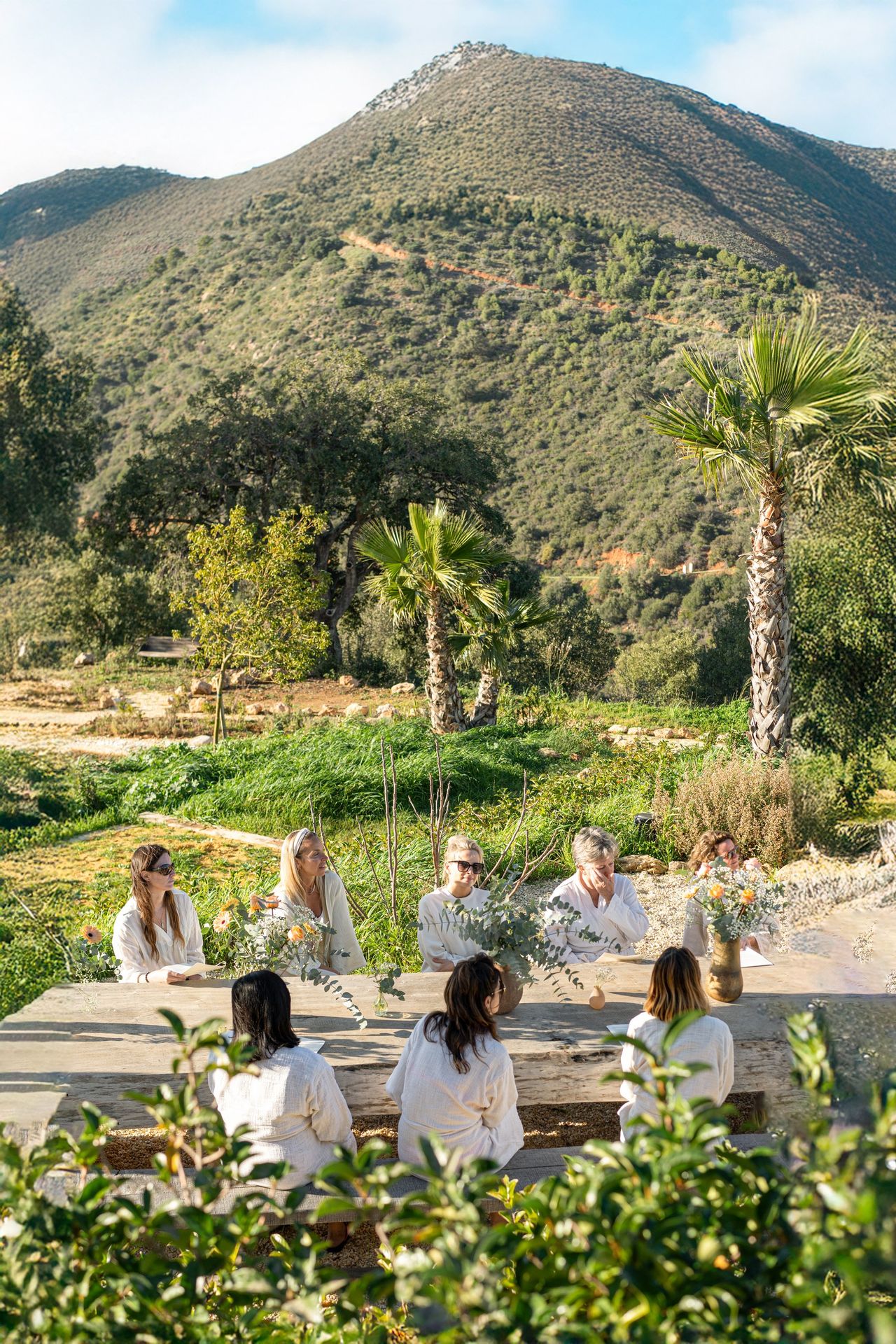
The oak table and bench, in daily use at Viluz Marbella
The Zola Sofa — The Same Story, Somewhere to Sink Into
A table you sit at. A bench you rest on. And then the Zola — the sofa that holds the lounge at Viluz the same way that table holds the terrace, except here the oak disappears under a seat so low and deep you do not want to leave it.
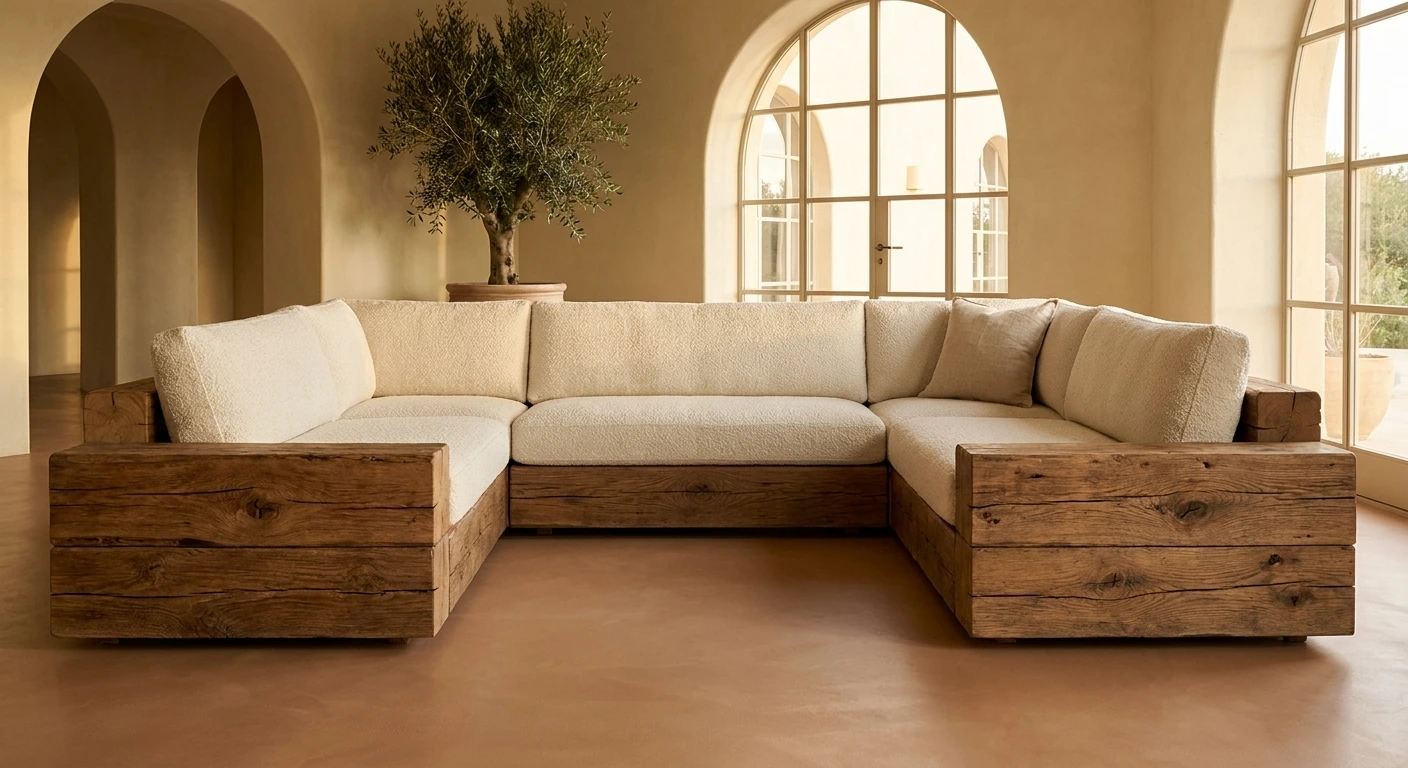
The Zola — massive reclaimed oak frame, cream boucle cushions
The frame is the same massive reclaimed oak as the table and the benches, visible along the base and the arms where the cushions do not cover it — each module showing its own grain, its own history, no two sections matching because no two beams ever match. Cream fabric cushions, woven from recycled yarn, soften the raw authority of the wood without hiding it. The Zola is fully modular — corner sections, centre sections, an ottoman — so it can be built to whatever scale a room needs, and it comes in both indoor and outdoor versions, in more than a dozen colourways.
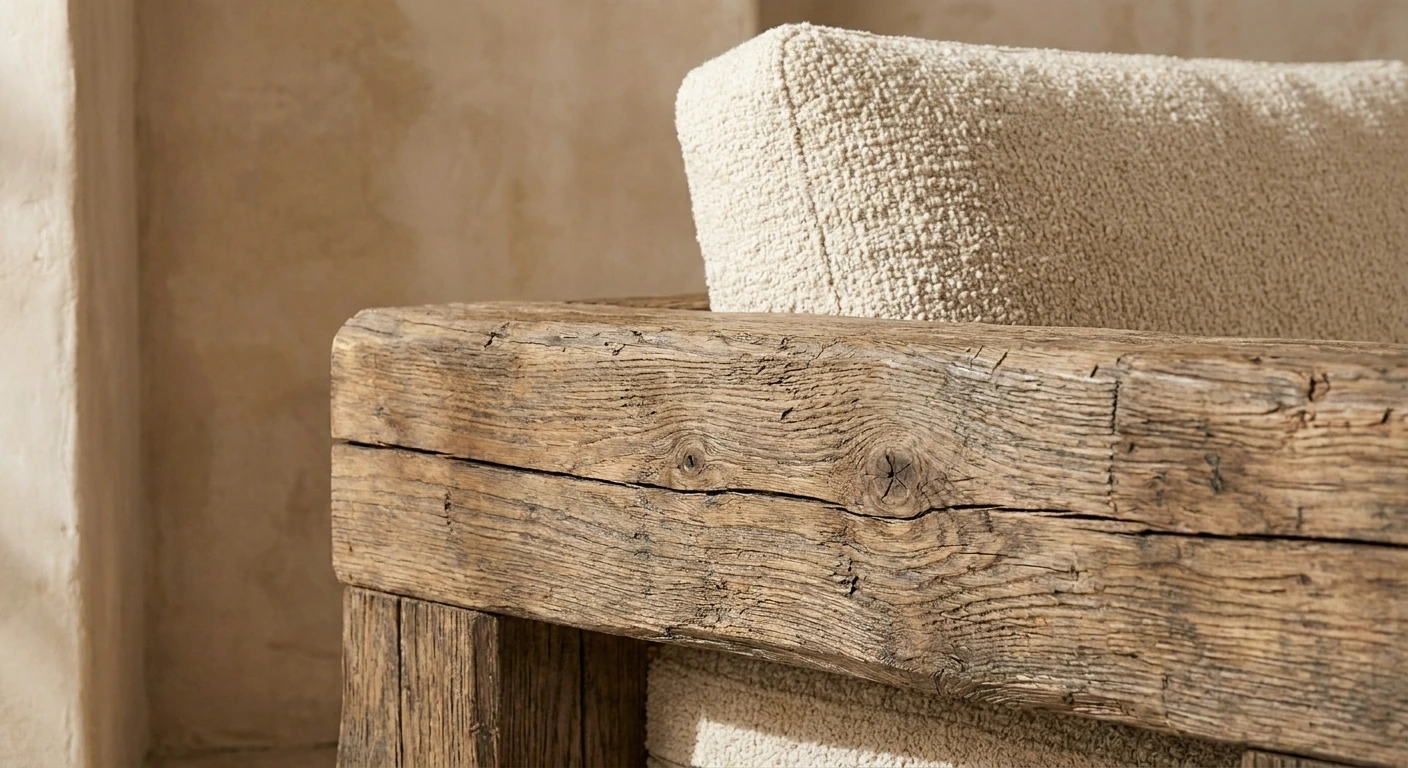
Grain, knots and history — no two beams ever match
What struck me is that a sofa this size, this comfortable, still reads as architecture rather than upholstery. You do not choose the Zola because it is soft. You choose it because it is the one soft thing in the room that still has weight — literally and otherwise.
Furniture Carved From Actual History
Here is what most people do not know about Oakâme, and what changed how I specify furniture for good.
The oak is not new-growth timber shaped to look old. It is reclaimed — beams pulled from 18th and 19th century buildings across Eastern Europe, structures that were coming down anyway, their timber salvaged before it could be lost. No trees felled for this. The grooves, the knots, the tobacco-coloured streaks, the fine cracks where the wood has moved over a hundred winters — none of that is added afterwards. It is what was already there. Oakâme's job is to notice it, not to fake it.
Every piece is then hand-built in northern France — the oak structure shaped by woodworkers, cushions filled with French foam and feathers for indoor pieces or UV-resistant foam for outdoor ones, fabric woven from recycled yarn. PEFC certification on any new timber in the chain. Ten years minimum guaranteed durability, though frankly the wood has already proven it can outlast a century, so ten years feels like the least of its concerns.
And because every beam is different, no two Oakâme pieces are the same. Not "limited edition." Not "hand-finished" in the way that usually just means a factory piece got sanded by a person instead of a machine. Actually, structurally, one of one. The table I sat at, the sofa in the lounge, the bench by the door — none of them will ever exist again, because the trees they came from will never exist again.
The Detail That Turns Furniture Into a Conversation
Every Oakâme piece — the benches at Viluz especially, models like Descartes, Debussy, Camus, Bocuse — carries a small NFC plate built into the wood. Hold your phone against it and you get the actual story: which region the beam came from, what kind of building it was part of, which century it stood in.
I have specified thousands of pieces of furniture. I have never been able to hand a client their sofa's biography.
This is not a gimmick, and I want to be clear about that, because it would be easy to dismiss it as one. For a client who has seen every finish, sat on every "artisanal" sofa in every showroom from here to Milan, this is the first piece of furniture that gives them something no amount of budget can fake — a real, traceable, unrepeatable history sitting in their living room. You are not selling a bench. You are handing someone a piece of Europe that happens to also be a place to sit down.
"A room needs one object that remembers something. Everything else can be new."
Why History Belongs Next to Engineering
Here is the thing I have had to sit with since that afternoon at the table.
Everything else I love about Viluz — the Terrae-Calce walls, the Solidro wet rooms, the Eclips pendant — is exceptional because someone engineered it to be exceptional. Precision, consistency, a controlled process that guarantees the same quality every time. That is real craft, and I do not say this to diminish it.
But a room made entirely of engineered perfection starts to feel, after a while, like it has no past. Oakâme is the correction. It is the one material at Viluz that was not made for the room — it arrived already carrying a life the room will never fully know. Placed against the calm, considered surfaces around it, the oak does not compete. It grounds. It is the sentence in the room that says: something existed here before any of this was designed.
I now specify at least one piece of furniture with real, documented history in every project I take on — not as decoration, as architecture. A room needs one object that remembers something. Everything else can be new.
Why This Matters for Every Designer on the Costa del Sol
Marbella clients have seen it all. Every showroom, every "exclusive" collection, every piece with a story invented by a marketing team after the fact. What they have not seen — because it does not really exist anywhere else in this market — is furniture where the history is structural, not decorative. Where you can put a phone against the wood and the story is simply true.
Oakâme's scale also matters here specifically. These are large, physically commanding pieces — built for rooms with height and volume, for the terraces and living rooms and hotel lobbies that define high-end Costa del Sol projects, not for apartments. And because the oak is naturally dense and weather-resistant, the outdoor range genuinely lives outdoors — ageing to a silvered grey on a terrace above the Mediterranean rather than needing to be protected from it.
Frequently Asked Questions
Oakâme Reclaimed Oak Furniture — Questions Designers Ask
Oakâme is a French brand of furniture hand-built from reclaimed 18th and 19th century oak beams, including the Zola modular sofa, dining tables and benches. Pieces are installed and in daily use at Viluz, a luxury wellness estate near Marbella that functions as the Olyra living showroom on the Costa del Sol. Contact Olyra representative Svetlana Dubova at svetlana@olyra-marbella.com to arrange a private visit.
Every Oakâme piece carries a small NFC plate built into the wood. Holding a smartphone against it reveals the beam's real history — which region it came from, what kind of building it was part of, and which century it stood in. No app is required.
Yes. Oakâme uses reclaimed oak beams salvaged from demolished 18th and 19th century buildings across Eastern Europe rather than newly felled timber. Fabrics are woven from recycled yarn, any new timber in the supply chain is PEFC-certified, and every piece is guaranteed for a minimum of ten years.
Oakâme furniture is showcased through Olyra at Viluz, a private wellness estate in the hills above Marbella, where pieces including the Zola sofa, dining tables and benches are installed and in real daily use. Private visits for architects, designers and developers can be arranged through Olyra representative Svetlana Dubova at svetlana@olyra-marbella.com.
Svetlana Dubova
Interior designer with 17 years of experience in luxury residential and hospitality design, based in Marbella. She is the exclusive Olyra representative on the Costa del Sol. Oakâme reclaimed oak furniture — including the Zola sofa, dining tables and benches — is available through Olyra Marbella.